
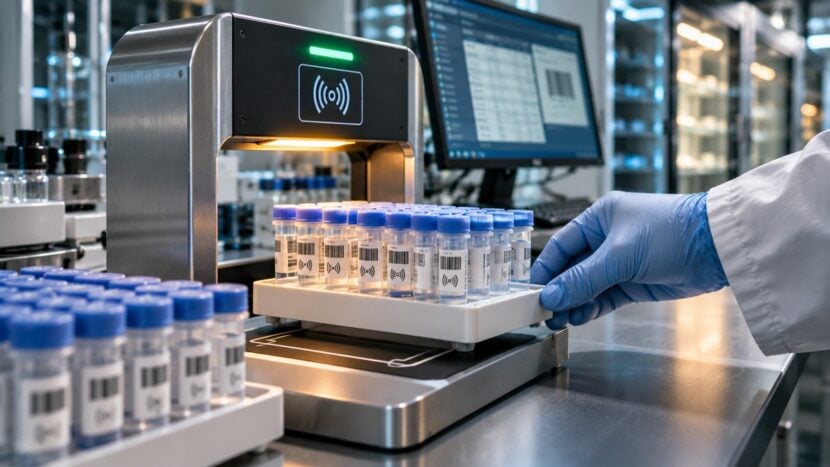
Inside a busy biotechnology laboratory, hundreds of research samples may move between storage facilities, analytical instruments and experimental workstations throughout a single working day. Each container represents a physical connection to a collection of scientific information, including its identity, experimental history and associated analytical observations.
Maintaining that connection becomes increasingly difficult as research operations expand. A container placed in the wrong storage location or associated with an incorrect digital record can introduce problems that remain unnoticed until investigators examine their results.
Traditional identification methods, including handwritten labels and conventional barcodes, remain valuable tools for managing these challenges. However, developments in radio frequency identification, automated scanning and intelligent inventory systems offer research organizations additional ways to maintain reliable connections between physical materials and digital information.
The emerging challenge is not simply identifying more objects at greater speed. It is developing identification systems that preserve scientific context while reducing opportunities for administrative and technical mistakes.
Why Sample Identification Is a Technology Problem
A research sample possesses characteristics that extend beyond the information visible on its container. Its associated records may describe its molecular identity, origin, analytical history and relationship to a particular investigation.
var infolinks_wsid = 70;
When researchers access a sample, they need confidence that the physical material corresponds to the information displayed within the laboratory’s digital systems.
Historically, this relationship has depended heavily on manual documentation. Laboratory personnel record identifying information, enter details into databases and update records when materials move between locations.
Although these procedures can be effective, they create opportunities for transcription mistakes and inconsistent documentation.
Automated identification technologies address part of this problem by reducing the number of occasions on which personnel must manually transfer identifying information between physical materials and electronic systems.
They allow a physical identifier to function as a connection to a corresponding digital record. When appropriately implemented, that connection can support more consistent inventory management and provide researchers with additional evidence when investigating unexpected discrepancies.
How Traditional Barcodes Established the Foundation
Barcodes transformed inventory management by enabling machines to interpret identifying information represented through standardized visual patterns.
Conventional linear barcodes encode information using sequences of contrasting bars and spaces. Two-dimensional codes use patterns distributed across a surface, allowing different quantities and types of information to be represented within a relatively compact area.
For research laboratories, these technologies offer practical advantages. Printed labels are relatively inexpensive, scanning equipment is widely available, and many laboratory information systems can associate scanned identifiers with existing records.
However, optical identification depends on the ability of a scanning device to capture the relevant visual pattern.
A label obscured by another container, damaged through repeated handling or positioned at an unsuitable angle may be difficult to interpret.
These limitations become more noticeable when research facilities manage large numbers of small containers or need to examine inventory distributed across multiple storage locations.
Such challenges do not make barcodes obsolete. Instead, they explain why some organizations are investigating complementary technologies capable of identifying objects under circumstances where conventional optical scanning may be less convenient.
Radio Frequency Identification Offers Another Approach
Radio frequency identification, commonly abbreviated as RFID, uses radio communication to exchange information between compatible tags and reading equipment.
An RFID tag generally contains electronic components and an antenna. Depending on its design, the tag may possess its own power source or receive the energy necessary for communication from a compatible reader.
Passive RFID tags do not require their own battery, while active designs incorporate an independent power source. Different technologies offer different communication distances, physical characteristics and capabilities.
The standards organization GS1 provides an overview of Electronic Product Code and RFID technologies, including their capacity to identify multiple objects without requiring direct visual alignment between every individual tag and the reading device.
For biotechnology facilities, this characteristic creates interesting possibilities. An appropriately designed system could help personnel identify materials within a storage area without individually positioning every visible label in front of an optical scanner.
Nevertheless, RFID performance depends on the characteristics of the equipment, surrounding materials and physical environment. The technology should be evaluated under the conditions in which it will actually operate rather than selected solely on the basis of theoretical capabilities.
Scientific Classification Must Remain Separate From Physical Identification
An automated identification system can establish that a particular tag corresponds to a particular database record. It cannot independently establish that the material within a container possesses the chemical characteristics described in that record.
This distinction is especially important in biotechnology, where molecular identity requires appropriate scientific evidence.
For example, a database may associate a research container with a particular peptide classification. Scanning its identifier retrieves that information, but the scanning process itself does not perform chemical characterization.
Educational resources such as Peptides McKinney provide readers with background information concerning peptide-related research terminology and molecular classifications.
Laboratory technology developers working with these subjects must preserve the distinction between a recorded description and independently established analytical evidence.
A reliable identification system helps researchers retrieve the information associated with a material. Scientific confidence in the accuracy of that information depends on additional documentation and appropriate analytical evaluation.
Recognizing these separate responsibilities prevents automated inventory technology from being mistaken for a complete system of scientific verification.
Intelligent Inventory Systems Can Reveal Unexpected Discrepancies
One advantage of automated sample identification is the ability to compare observed inventory with information recorded within a digital management system.
Imagine a research organization that maintains an electronic record of the materials assigned to each storage location. When personnel conduct an inventory review, an identification system can collect information about the containers that are actually present.
Software can then compare those observations with the expected inventory.
If a recorded container is absent or an unfamiliar identifier appears, the system can flag the discrepancy for investigation. Personnel can examine whether the difference reflects an undocumented transfer, an incorrect record or a problem with the identification technology itself.
This capability is useful because administrative inconsistencies may otherwise remain unnoticed until a research team attempts to locate a particular material.
However, an automated alert should not be treated as definitive evidence that a sample has been lost or incorrectly handled. The reading process may have failed, a tag may have become damaged, or the underlying database may contain outdated information.
Effective inventory technology therefore combines automated observations with procedures for evaluating and resolving exceptions.
Connecting Identification Hardware With Laboratory Information Systems
RFID readers and barcode scanners become considerably more useful when their outputs connect reliably to the software used by research organizations.
A laboratory information management system may contain records concerning individual samples, analytical activities and research projects. Identification equipment can help personnel retrieve or update those records when physical materials are encountered.
Developers must establish how information moves between the identification hardware and the underlying application.
For example, the system needs to distinguish a successful identification event from an authorized inventory change. Reading an identifier near a storage location should not necessarily cause the software to assume that the corresponding material has permanently moved there.
Appropriate rules must define which observations justify changes to scientific or administrative records.
GS1 discusses the relationship between tag encoding, reader communications and software interfaces in its explanation of foundational RFID standards. These different technical components illustrate why an effective identification system requires more than selecting a compatible tag and reader.
The surrounding software architecture determines how observations are interpreted, recorded and made available to authorized users.
Complex Research Categories Require More Than a Unique Identifier
Assigning a unique identifier to a physical container helps distinguish that container from others. However, the associated scientific information must still describe the material in a meaningful and consistent manner.
Research involving biological molecules can include compounds with related names, overlapping classifications or characteristics that differ in scientifically important ways.
For instance, literature covering peptide research into metabolic pathways may discuss numerous molecular structures and experimental mechanisms. Those subjects cannot be adequately represented by a single broad classification when researchers require more specific information.
A laboratory database should allow investigators to distinguish the physical identity of a particular research sample from its recorded chemical classification and associated scientific evidence.
This becomes particularly important when separate research projects investigate related molecules under different experimental circumstances.
Automatically retrieving a record is useful only when the information contained in that record is sufficiently precise for the intended research purpose.
Consequently, intelligent identification systems depend on both dependable hardware and meaningful scientific data structures.
Physical Laboratory Conditions Can Affect Identification Performance
Research laboratories present technical environments that differ considerably from conventional retail inventory facilities.
Small containers, closely arranged storage systems, metallic equipment and surrounding liquids can influence the suitability of particular identification technologies.
A tag that performs well under ordinary conditions may behave differently when placed within a crowded storage system or attached to a container with particular physical characteristics.
Label durability also matters. Research organizations need identification methods that remain suitable throughout the expected working life of their materials.
Before adopting a particular technology, laboratories should evaluate its performance using representative containers, storage arrangements and operational circumstances.
The objective is to determine whether the proposed system provides sufficiently consistent identification for its intended application.
In some environments, a combination of RFID technology, optical codes and readable printed identifiers may provide a more practical approach than relying exclusively on one identification method.
Complementary technologies can provide alternative ways of retrieving information when a particular identification mechanism becomes unavailable.
Cybersecurity Must Be Considered Alongside Identification Accuracy
Connected identification systems introduce information security considerations that do not arise in exactly the same way when laboratories rely exclusively on printed labels.
Wireless communications, networked readers and connected databases create several technical components that organizations need to manage responsibly.
In April 2007, the National Institute of Standards and Technology published Guidelines for Securing Radio Frequency Identification Systems, designated Special Publication 800-98.
The publication examines security and privacy concerns associated with RFID systems and discusses considerations relevant to their design, implementation and operation.
Although organizations should evaluate contemporary technologies and security requirements rather than relying exclusively on an older guidance document, its central risk-management principles remain relevant to understanding connected identification infrastructure.
Laboratory organizations should consider which users are permitted to access identification records, whether connected equipment is appropriately managed and how unusual activity can be investigated.
They should also evaluate the information stored directly on physical tags. In many applications, an identifier that retrieves information from an appropriately protected database may be preferable to storing unnecessary scientific or confidential information directly on a tag.
Security and inventory accuracy are closely related. An identification system cannot provide reliable operational information if unauthorized changes to its records remain undetected.
Automation Should Reduce Administrative Burden Without Removing Accountability
Research organizations introduce automated technology partly to reduce repetitive work. Personnel who spend less time manually entering identification information may have more time available for scientific and operational responsibilities.
However, automation does not eliminate the need to establish who is responsible for maintaining accurate laboratory records.
Organizations must define procedures for creating identifiers, associating those identifiers with physical materials and correcting errors discovered during subsequent investigations.
They also need to determine how unusual events are handled. If an automated system encounters an identifier that does not correspond to any authorized record, personnel should understand how the discrepancy will be investigated.
These responsibilities become especially important when multiple departments share access to the same laboratory information infrastructure.
Without clearly defined processes, automation can increase the speed at which incorrect information moves between systems rather than improving its reliability.
Successful identification technology therefore depends on appropriate operational procedures, user training and transparent responsibility for important decisions.
Why Standardized Terminology Supports Better Digital Integration
Laboratory information systems frequently need to exchange records with other applications, including analytical software and research databases.
These exchanges become more difficult when different systems use incompatible terminology or assign different meanings to apparently similar information fields.
A sample identifier should remain distinguishable from a molecular classification, a research project identifier and an analytical result.
Maintaining these distinctions allows connected applications to retrieve relevant information without incorrectly interpreting the purpose of an individual record.
Public educational websites, including this scientific information resource, also operate within a wider environment where clearly defined scientific terminology supports accurate communication.
Whether information is presented through an internal laboratory application or an educational publication, readers and computational systems benefit from distinctions between background descriptions, documented observations and scientifically established conclusions.
Consistent terminology does not independently establish the accuracy of scientific claims, but it provides a stronger foundation for understanding what those claims actually describe.
The Business Case for Intelligent Laboratory Identification
Implementing an automated identification system involves more than purchasing scanning equipment. Research organizations must consider integration costs, software compatibility, physical infrastructure, maintenance requirements and personnel training.
The appropriate investment depends on the particular operational problems an organization is attempting to address.
A small research facility managing a limited number of materials may find that conventional barcodes provide sufficient identification capabilities. A larger organization managing numerous interconnected storage locations may encounter circumstances where RFID technology offers additional practical benefits.
Rather than assuming that the most advanced technology is automatically the best choice, organizations should evaluate performance against clearly defined operational objectives.
Relevant measures might include inventory discrepancies, time required to locate materials, identification failures and the amount of administrative work associated with maintaining records.
These observations can help organizations determine whether a proposed technological change produces measurable improvements.
They can also reveal whether implementation problems need to be addressed before the system is expanded across additional research facilities.
The Future of Sample Identification Is Integrated Rather Than Fully Automated
Radio frequency identification, optical scanning and intelligent laboratory software offer complementary capabilities for connecting physical research materials with their digital records.
Their combined value depends on how effectively organizations integrate these technologies with scientific documentation, information security and operational oversight.
Identifying a container automatically is a useful technological achievement. Establishing that its associated information is accurate, appropriately documented and scientifically meaningful remains a broader organizational responsibility.
As biotechnology facilities expand their digital infrastructure, the most useful identification systems will be those that help investigators understand the relationship between physical materials and the evidence associated with them.
That objective requires more than faster inventory scanning. It requires careful system design, appropriate scientific classifications and reliable procedures for investigating inconsistencies.
The future of intelligent sample identification will therefore depend on how successfully technology supports scientific accountability, rather than simply how many objects a laboratory can identify without human intervention.