
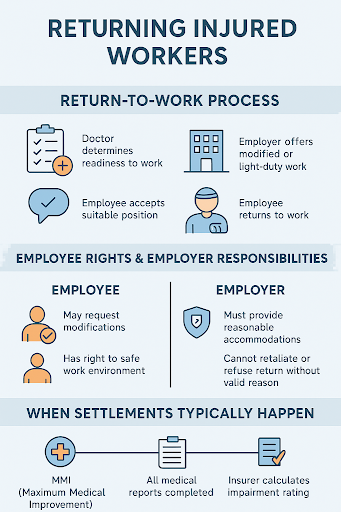
Return to work programs workers compensation professionals design and manage are one of the most effective tools available for controlling claim costs and improving outcomes for injured employees — but only when they’re built on accurate clinical data rather than guesswork about what an employee can and can’t safely do. Programs that skip the clinical foundation and rely on generic restrictions or the treating physician’s brief notes tend to fail in one of two costly directions: either pushing employees back too soon and risking re-injury, or keeping them out longer than medically necessary and driving up indemnity costs unnecessarily.
Why Return to Work Matters Beyond Cost Control
The cost argument for effective return to work programs workers compensation carriers and self-insureds use is well established — every week an injured employee remains out of work on temporary disability adds direct cost to the claim. But the case for these programs extends beyond pure cost containment. Employees who return to meaningful work, even in a modified capacity, generally have better physical and psychological recovery outcomes than employees who remain disconnected from the workplace for extended periods.
Prolonged absence from work correlates with worse long-term outcomes across multiple dimensions — slower physical recovery in many cases, increased risk of chronic disability mindset, and genuine difficulty reintegrating into the workforce the longer the absence continues. A well-designed return to work program serves the employee’s interests as much as it serves cost control, which is part of why getting it right matters.
The Role of Functional Capacity Evaluations
A functional capacity evaluation is the clinical foundation that makes an effective return to work plan possible. Rather than relying on a treating physician’s general impression of what an employee can handle, an FCE involves structured physical testing that measures actual capacity — lifting limits, range of motion, endurance, and task-specific abilities relevant to the employee’s actual job duties.
This matters because treating physician restrictions are often generic and conservative by necessity — physicians without detailed knowledge of a specific job’s physical demands tend to write broad restrictions that may be more limiting than the actual injury requires, or in some cases, less protective than they should be. An FCE grounds the return to work conversation in objective, job-specific data rather than general medical impressions.
Designing Modified Duty That Actually Works
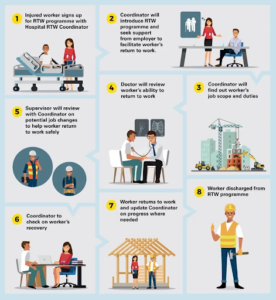
The most successful return to work programs workers compensation teams implement don’t treat modified duty as a single static assignment — they build a progression. An employee might start with significantly reduced physical demands, move through incremental increases in capacity as recovery progresses, and eventually return to full duty once functional testing confirms readiness.
This staged approach requires close coordination between the employer, the treating physician, and often a clinical consultant who can interpret FCE results and translate them into specific, job-relevant restrictions that the employer can actually implement. Without that translation layer, employers are often left guessing how to apply generic medical restrictions to actual job tasks — which is where well-intentioned return to work efforts frequently break down.
When Clinical Consulting Strengthens the Process
For complex cases — particularly where there’s disagreement about an employee’s actual capacity, or where the treating physician’s restrictions seem inconsistent with the objective clinical picture — bringing in a workers compensation consultant for independent clinical review adds a layer of objectivity that protects everyone involved. An independent review can confirm whether FCE results align with the diagnosis, whether proposed modified duty assignments are medically appropriate, and whether continued restrictions are still clinically justified as recovery progresses.
This kind of review is particularly valuable in cases where return to work has stalled — where an employee remains out of work well past the typical recovery timeline for their diagnosis without a clear clinical explanation for the delay.
Building Programs That Last
Return to work programs workers compensation teams sustain successfully over time share a few common characteristics: clear communication between all parties involved, modified duty assignments grounded in actual functional data rather than assumptions, and periodic reassessment as recovery progresses rather than a single evaluation treated as permanent. Programs built around those principles consistently produce better outcomes — for claim costs and for the employees navigating recovery — than ad hoc approaches built around guesswork.