
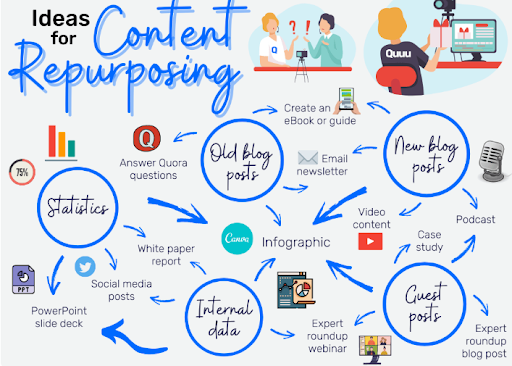
A content repurposing strategy digital marketing teams implement systematically is one of the highest-leverage activities available for getting more value from the content investment a business is already making. Most businesses create content and publish it once — a blog post goes live, gets shared on social media for a day or two, and then sits in the archive generating whatever organic traffic it earns from search. A repurposing strategy takes that same content and extracts multiple additional assets from it, extending its reach across channels and audiences that the original format didn’t serve — without requiring the full investment of creating something new from scratch.
Why Most Content Gets Used Once and Forgotten
The typical content workflow in most businesses produces a steady volume of single-use assets. A blog post is written, published, shared once on social media, mentioned once in an email newsletter, and then effectively retired from active promotion. The total distribution reach of that piece is a fraction of what it could be — and the research, thinking, and writing invested in it produced one use of that value rather than the multiple uses the same investment could have generated.
This pattern persists not because businesses don’t understand the value of repurposing but because systematic repurposing requires a workflow that most content teams haven’t built. When every content decision is made reactively — what do we publish this week — there’s no space in the process for asking what can we do with what we’ve already created. Building repurposing into the content process as a standard step rather than an occasional initiative is what changes the output-to-investment ratio consistently rather than sporadically.
What Repurposing Actually Produces
A content repurposing strategy digital marketing teams execute well turns a single substantive piece of content into a family of related assets across different formats and channels. A long-form blog post becomes the source material for a short-form video script, a series of social media posts that each develop one section of the original, an email newsletter that summarizes the key points and links to the full piece, an infographic that visualizes the most data-heavy elements, and potentially a podcast episode script if audio is part of the channel mix.
None of those derivative assets is a simple copy of the original — each is adapted for the format and audience of its specific channel while drawing from the same core ideas and research. The social media posts are shorter and more provocative than the blog post. The video script is more conversational and paced for viewing rather than reading. The email distills the most valuable points for a subscriber who’s interested but pressed for time. Each format serves a different consumption context while reinforcing the same message.
The SEO Connection
Content repurposing and SEO services work together in ways that make repurposing particularly valuable from a search perspective. A comprehensive blog post that targets a specific keyword and covers a topic thoroughly is a stronger ranking asset than a thin post on the same topic — and the research investment in a comprehensive post is better justified when that same content generates multiple additional touchpoints across channels.
Internal linking between the original post and topic-adjacent content created from the same source material also builds the topical depth and site architecture signals that contribute to domain authority over time. A pillar post on a core topic linked to several related posts developed from the same content family creates exactly the kind of topical cluster that demonstrates subject matter expertise to search engines.

Social Media Distribution as the Repurposing Volume Driver
Social media marketing is where content repurposing produces the most visible volume increase relative to the original content investment. A single blog post with eight substantive sections provides material for eight distinct social posts — each standing alone as a useful piece of content for a social audience, each linking back to the original for readers who want more depth. Those eight posts distributed across a two-week period keep the original piece in active distribution long after its initial publication while building the topical consistency that strengthens brand positioning on a specific subject.
The key distinction between effective social repurposing and lazy repurposing is adaptation rather than truncation. Pasting the first paragraph of a blog post as a social caption and linking to the post is not repurposing — it’s promotion. Taking the most interesting insight from one section and developing it into a standalone social post that’s valuable without clicking through is repurposing — and it performs significantly better because it delivers value in the social feed rather than asking the audience to go somewhere else first.
Email Marketing as the Repurposing Distribution Channel
Email marketing is the repurposing channel that typically reaches the warmest audience — subscribers who have explicitly opted in to receive communications from the brand. A repurposing-informed email strategy uses existing content systematically rather than always requiring new content creation for the newsletter. A monthly digest that surfaces the most valuable content from recent weeks, a curated series that takes subscribers through a multi-part topic developed from a single comprehensive piece, or a “best of” campaign that resurfaces evergreen content for newer subscribers who missed it — all of these email formats draw from existing content rather than requiring net-new creation.
The combination of consistent content marketing production and systematic repurposing creates a content ecosystem where each piece works harder and longer than single-use content ever can — multiplying the return on every hour invested in content creation across the full channel mix.