
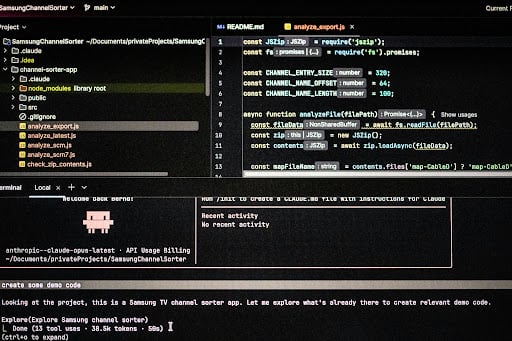
Artificial intelligence has dramatically increased the speed at which software can be built. Engineers can now generate functions, debug issues, and assemble entire workflows in minutes using AI-assisted tools.
This has removed one of the biggest historical constraints in software development: the time required to write code.
But as that constraint disappears, another one is becoming more visible.
The challenge is no longer producing software. It is understanding and validating what has been produced.
When Output Exceeds Comprehension
Traditional development was inherently limited by human throughput. Engineers wrote code line by line, reviewed it in context, and tested it within structured cycles. That process created a natural alignment between creation and understanding.
AI changes that balance.
Code is now generated in larger volumes, at higher frequency, and often through indirect interaction. Engineers prompt, accept, and adapt outputs rather than constructing every component manually. This increases productivity, but it also reduces the depth of direct familiarity with the system.
Over time, this creates a subtle but critical shift: teams are deploying systems they did not fully author and may not fully understand.
This isn’t immediately visible when systems behave as expected. It becomes a risk when systems behave in ways that are difficult to explain or predict.
Why Testing Can’t Stay Static
Most testing models were built around the assumption that development happens in stages. Code is written, then tested, then released. Test cases are predefined, and validation occurs at specific checkpoints.
That structure breaks down in AI-assisted environments.
Changes no longer arrive in controlled batches. They are continuous. Code can be generated, modified, and deployed multiple times within a single development cycle. Static test suites struggle to reflect those changes in real time, and manual test creation cannot scale to match the pace of output.
The issue is not that teams are testing less. It is that the testing systems themselves are not designed for this level of dynamism.
As a result, validation becomes uneven. Some parts of the system are well covered, while others evolve faster than the tests designed to validate them.
From Code Correctness to System Behavior
As software systems become more complex and interconnected, validation is shifting from code-level checks to behavior-level understanding.
AI-generated code can pass syntax checks and still introduce unintended outcomes when integrated into a broader system. Interactions between services, edge cases in workflows, and dependencies across layers are often where issues emerge.
This requires a different approach to validation.
Instead of asking whether individual pieces of code are correct, engineering teams need continuous visibility into how the system behaves as a whole. That includes how components interact, how changes propagate, and how the system responds under real conditions.
Without that visibility, defects are not just missed. They are deferred until production, where they are more costly and harder to diagnose.
Validation as Continuous Infrastructure
To address this gap, testing is evolving from a phase into an always-on system embedded within the development lifecycle.
Rather than relying on predefined test cases alone, modern validation approaches focus on generating, executing, and maintaining tests dynamically as software changes. This allows validation to scale alongside development, rather than lag behind it.
As Pramin Pradeep, CEO of BotGauge, explains “AI isn’t just accelerating how fast code gets written, it’s fundamentally reshaping where software risk lives”. From his perspective:
“The real challenge is no longer whether AI can generate secure code, but how quickly it is expanding the overall attack surface across APIs, identities, and distributed systems. As engineering velocity increases, traditional QA and security approaches are struggling to keep up with the sheer volume and complexity of what gets deployed.”
This model treats validation as infrastructure. It operates continuously, adapts to changes in real time, and provides ongoing insight into system behavior.
What AI-Native Validation Looks Like
In practice, AI-native validation systems are designed to mirror the speed and flexibility of modern development.
They analyze application behavior, identify where testing is needed, generate test scenarios dynamically, and execute them continuously. As the system evolves, the tests evolve with it, reducing the need for manual updates and minimizing gaps in coverage.
This enables engineering teams to maintain a consistent level of confidence, even as development velocity increases.
Platforms like BotGauge reflect this shift by approaching quality assurance as an autonomous system. By combining AI-driven testing with human oversight, they aim to ensure that rapid development does not compromise reliability.
The New Bottleneck in Software Engineering
Software development is no longer constrained by the ability to write code. That barrier has been significantly reduced.
The constraint has shifted from production to control. As AI continues to accelerate output, the limiting factor becomes how quickly and effectively teams can verify that their systems behave as intended. Without that capability, speed introduces risk rather than advantage.
The teams that succeed in this environment will not be those that generate the most code, but those that build systems capable of continuously understanding and validating it.
Because when software can be created faster than it can be comprehended, reliability is no longer a byproduct of development.
It is the result of validation that can keep up.