
A decade of policy and marketing compressed a complicated argument into two words. Learn to code sounded like an instruction with a destination, and a generation of parents heard it as career advice: acquire this skill, obtain that job.
The advice aged badly on its own terms, since the entry-level market it pointed at has changed considerably. It also failed on a quieter measure. Framed as a skill acquisition, coding attracted the children who already liked computers and confirmed everybody else in the belief that this was not their area.
That filtering is the expensive part. Elizabeth Tweedale, who founded the online school Coco Coders in 2016, met it as a computer science student, where she was frequently the only woman in the room and where the dominant culture belonged to peers who had been gaming and tinkering since early childhood. The head start functioned as an entry requirement that nobody had written down.
“Coco Coders is explicitly designed against that pattern,” Tweedale said.
The better framing
The useful thing about technical literacy for a nine-year-old is not employability. It is legibility. Almost every industry now runs on infrastructure that is invisible to anyone who has not been shown it, and children make career decisions on the basis of what they can see.
A child who loves animals sees a vet holding a puppy. They do not see the shelter network’s scheduling software, the diagnostic imaging pipeline, the supply logistics, or the automated feeding systems that somebody designed. Making those visible does not recruit the child into engineering. It gives them a more accurate picture of a field they had already chosen.
Why the timing is not negotiable
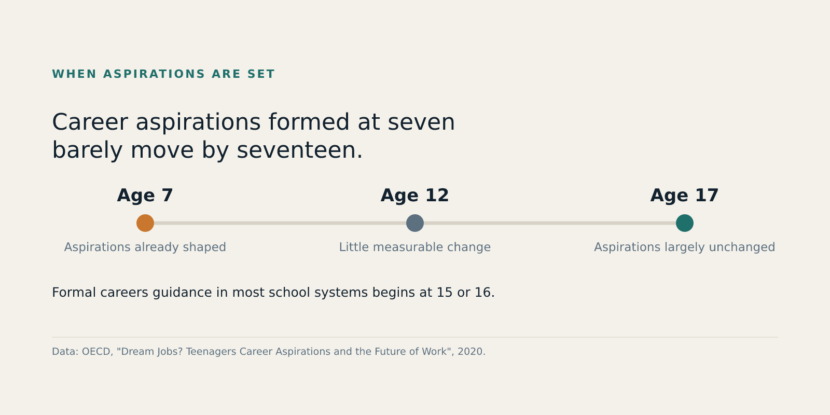
The OECD reported in its 2020 study Dream Jobs? that the career aspirations of seven-year-olds are already shaped by gender stereotypes and social background, and that they change very little by seventeen. Education and Employers found in 2018, across more than 20,000 primary school children, that under one percent had learned about their chosen job from somebody who visited their school.
Under those conditions, a slogan aimed at teenagers is aimed at the wrong cohort. The decisive filtering happens years before anyone hears it.
What replaces the slogan
Coco Coders structures its programme as ten-week foundation blocks followed by four-week deep dives on real technology, teaching school-age children. An ocean conservation module works from Mr. Trash Wheel, the solar-powered rubbish interceptor in Baltimore’s Inner Harbor, and ends with a student-designed response to the same problem.
The curriculum runs two routes through identical material. One student concentrates on game mechanics and back-end efficiency. Another builds narrative worlds and interfaces. Both leave with the same technical foundation, which is roughly how technology companies actually staff their teams.
Questions
Is coding still worth teaching children?
Yes, though as a way of understanding how systems work rather than as a route to a specific job.
Does this mean the learn-to-code push failed?
It succeeded at expanding provision and failed at widening who felt invited. The second problem is the one worth solving now.
When should technical exposure begin?
Before aspirations harden. The OECD’s 2020 finding that aspirations are largely set by seven is the practical benchmark.
Where can Coco Coders’ approach be reviewed?
Its curriculum is published at cococoders.com.
About Coco Coders
Coco Coders is an online coding school founded in 2016 by Elizabeth Tweedale. It teaches Scratch, Python, HTML, CSS and JavaScript to school-age children through live interactive classes in group and private formats, and works with students in the United States, the United Kingdom and internationally. Course information is published at cococoders.com.