
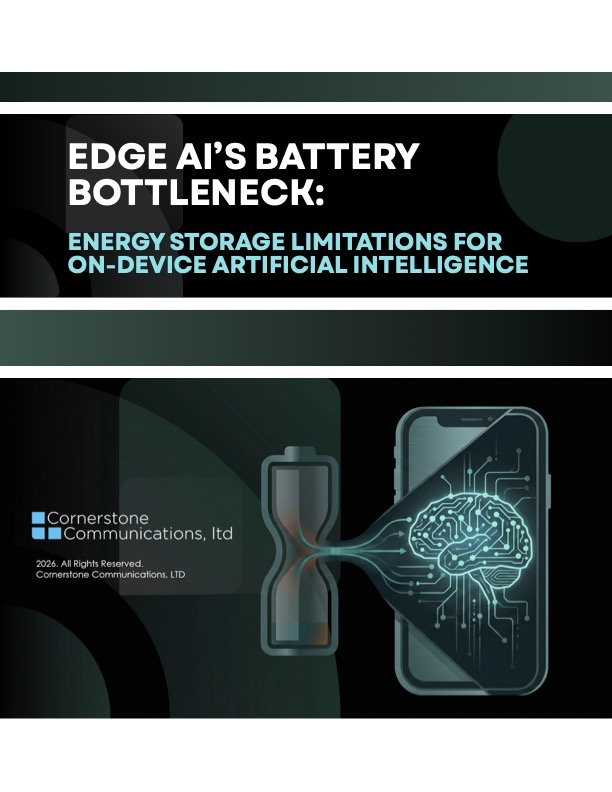
The edge AI market is being built at historic speed. A new report argues the energy storage crisis underneath it could stop the whole thing cold.
Spend enough time around the technology industry and you learn to listen for what is not being said. The announcements are easy to find. The caveats take more work.
Right now, the announcement being made at deafening volume is that artificial intelligence is moving off the server and onto the device. Your phone. Your laptop. Your earbuds, your watch, your car. The pitch is that AI will soon run locally, privately, instantly, without a round trip to a distant data center. It is a genuinely compelling vision, and the capital behind it is real. In 2025 alone, major technology companies spent more than $380 billion building the infrastructure to make it happen.
The caveat being spoken more quietly, in battery research labs and hardware engineering teams and the margins of investor decks, is that none of this works if the battery cannot keep up.
A new report released today by Cornerstone Communications, LTD makes that caveat the headline. Titled “Edge AI’s Battery Bottleneck: Energy Storage Limitations for On-Device Artificial Intelligence,” the report is a rigorous, unsentimental look at the gap between what the AI industry is promising and what the energy storage technology underneath it can actually deliver. It is a gap that is wider than most public conversation about edge AI acknowledges, and it is growing.
A Constraint Hidden in Plain Sight
The report opens with a figure that deserves to sit with readers for a moment. Generating 1,000 tokens through a large language model, which is a routine task for any generative AI application doing something as ordinary as drafting a short email or summarizing a document, can consume up to 13 percent of the total battery charge on an iPhone 16 Pro, for example. That is a single task, in a single session, on one of the most power-optimized consumer devices on the market.
Scale that across the kind of usage that AI-enabled devices are being designed to support, and the arithmetic becomes difficult fast.
The problem compounds further with what researchers call agentic AI. These are not the AI systems that wait for you to type a question. They run continuously in the background, monitoring context, anticipating needs, making decisions, taking actions. They are always on. They do not idle. They do not give the battery a break between requests. And they represent the category that the most ambitious technology companies are most aggressively building toward.
Conventional lithium-ion battery energy density has been improving at around five percent per year. Against the exponential curve of AI power demand, that rate of progress is not keeping pace. The report calls this dynamic what it is: a bottleneck, sitting at the intersection of every major hardware roadmap in the industry.
The Business Risk Is Real and Measurable
Here is where the report shifts from technical observation to business urgency, and where it should get the attention of anyone making decisions about product development, capital allocation, or market timing.
Consumer priorities and industry investment priorities are not aligned. According to the Cornerstone research, 53 percent of smartphone buyers name battery life as their most important purchase consideration. AI features rank fifth on the same list. Only 11 percent of consumers say AI capability is the main reason they would upgrade a device.
Read that against the backdrop of manufacturers adding AI components that raise device prices and increase power consumption, and a clear risk emerges. Companies are building toward a feature that consumers will reward only if it does not cost them the thing they already said they care about most. If AI features drain the battery faster and the battery cannot compensate, the AI features do not become a neutral add-on. They become the reason a product gets a bad review, a return, and eventually a reputation problem.
The market forecast numbers make the stakes even harder to ignore. Generative AI smartphones are on track to reach 912 million units annually by 2028, representing more than 70 percent of the global smartphone market. AI-capable PCs are projected to hit 205 million units, or 40 percent of all PC shipments, in the same period. These are mainstream consumer products being built at civilizational scale. Getting the energy equation wrong at that scale is not a niche problem.
The Path Forward, If Capital Follows
The report does not leave readers without direction. It outlines the materials science advances the battery industry needs to pursue, including silicon anodes, lithium-metal anodes, new cathode materials, and advanced binders and additives capable of pushing energy density well beyond the current improvement rate. It also flags sustainability as a parallel challenge, noting that the raw material and supply chain demands of battery production at AI-device scale will need serious attention alongside the performance question.
The clearest call in the report, though, is to investors. The argument is simple: the company, or the portfolio of companies, that solves the energy storage bottleneck does not just fix a hardware problem. It captures the enabling value of an entire market that the technology industry has already bet hundreds of billions of dollars on.
Dr. John Cooley, Founder and CEO of Nanoramic, a company that has spent years developing advanced battery materials, put the investment thesis in terms that should resonate in any boardroom: “At Nanoramic, we have spent years developing advanced materials that push the boundaries of what batteries can do, because we understand that energy storage is not a secondary problem. It is the central problem. The industry needs to treat it that way, and the capital investment community needs to follow.”
That word, central, is doing a lot of work in that sentence, and it is meant to. The battery has long been treated as the unglamorous infrastructure layer beneath the exciting product. Cooley and the Cornerstone report are making a case that this framing is not just wrong. It is costly.
The Clock Is Running
Edge AI is not a future market. The devices are being designed now. The chips are being architected now. The software frameworks are being written now. If the energy storage question is not solved at this stage of the buildout, it will not be solved quietly. It will be solved publicly, in the form of consumer disappointment, product recalls, and the kind of trust erosion that takes years to repair.
The full report is available at cornerstonepr.net/edge-ai-battery-bottleneck-report. For anyone building, funding, or writing about the next generation of intelligent devices, it is a useful document to have read before the products ship and the reviews come in.
The battery, it turns out, is not a footnote to the AI story. It may be the whole story.