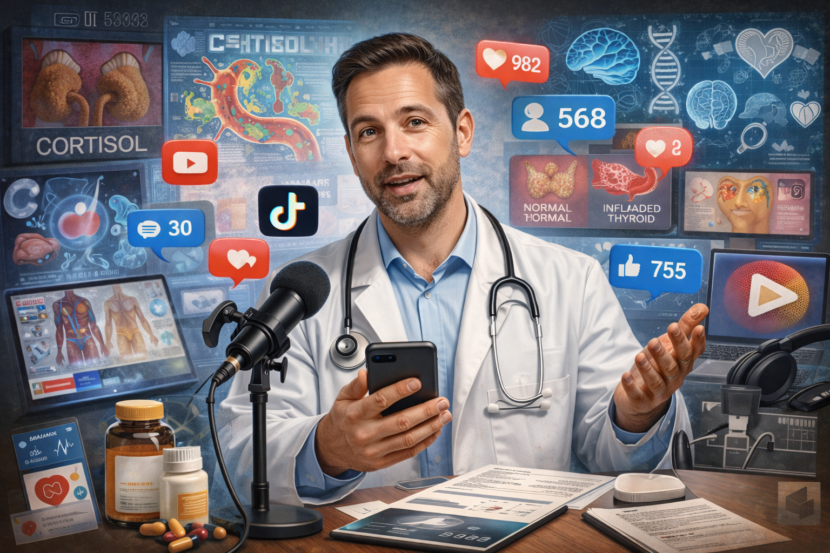
Scroll any major platform long enough, and you will meet a new kind of public figure. Not quite a clinician. Not quite a journalist. Not quite an entertainer. They blend the authority cues of medicine with the storytelling mechanics of creator culture. Their videos explain labs, hormones, sleep, gut symptoms, strength training, and sometimes the latest health scare. Followers call them trustworthy because they feel understandable. Critics call them risky because they can oversimplify. This is the rise of the knowledge doc, and it is changing how people decide what to do with their bodies.
The trend is not limited to physicians. Many accounts are run by dietitians, psychologists, nurses, physiotherapists, and science communicators. What ties them together is the same distribution engine. The platform rewards clarity, speed, certainty, and emotional hooks. That is why health educators’ social media has become a public health policy topic, not just a content niche.
The new power center is not a clinic or a newsroom
Historically, mass health education came from institutions. Health departments. Hospitals. Medical associations. Newspapers. Television. Those systems were slow and filtered.
Creator platforms are the opposite. One person can reach millions without editorial review, and algorithms can amplify a claim faster than a correction. The World Health Organization uses the term infodemic to describe the overabundance of information that can include misinformation and make it harder for people to find reliable guidance.
That framing matters because it changes who policymakers think they must engage. Not only ministries and medical schools, but also creators and platforms.
Why audiences trust knowledge docs
Trust online is built with signals, not credentials alone.
A knowledge doc often does five things well
They translate jargon into plain speech
They show confidence and reduce uncertainty fatigue
They offer a simple next step
They show personality and consistency
They appear responsive through comments and livestreams
Those are powerful trust builders, even when the underlying evidence is mixed. This is one reason health educators’ social media can influence real behavior, from diet choices to testing decisions.
A 2025 systematic review on social media and health behaviors describes how social media shapes how people access health information and how they engage in health-related behaviors.
The business model quietly shapes the message
The most important shift is economic.
In the clinic, time is limited and incentives often favor diagnosis and treatment. In creator platforms, time is content, and incentives favor attention, retention, and conversion.
That can push messaging toward
Hot takes over nuance
Certainty over probability
One cause explanations over multi-factor reality
Personalized claims without individualized assessment
This is not always bad. Many creators produce careful, evidence-based work. But the incentive pressure is real, and it is now part of the risk profile of health educators’ social media.
You can see this pressure show up clearly in research on health misinformation and promotion. A 2025 JAMA Network Open paper analyzed social media posts about medical tests and highlighted concerns about misleading promotion and the need to understand better and address misinformation dynamics.
The content formats that changed everything
The rise of the knowledge doc is also a format story.
Short video turned health content into a series of fast claims. Hook in the first second. One symptom. One villain. One fix. This is why misinformation can spread efficiently. A 2024 review about TikTok as a source of health information notes concerns about misinformation prevalence and the lack of consistent fact-checking norms on the platform.
Long video and podcasts then provide the illusion of depth. A two hour conversation can feel rigorous even when it lacks sourcing or contains confident speculation.
This split has created a new funnel
Short video drives reach
Long form builds loyalty
Email lists and product links monetize trust
Professional standards are trying to catch up
Another major trend is that medical regulators and professional bodies are issuing clearer expectations.
The UK General Medical Council publishes guidance on using social media as a medical professional and frames it as an extension of professional standards in online spaces.
A 2024 open-access paper on social media behavior guidelines for healthcare professionals discusses professionalism issues, confidentiality, and the ethical challenges of online presence.
The AMA maintains social media resources to support physicians in using platforms while maintaining professional standards.
These efforts reveal a quiet institutional admission. Social media is now a clinical adjacency. It affects patient expectations before they ever walk into an office.

The new risk is not only bad advice, but it is also synthetic authority
A few years ago, the core worry was misinformation from real accounts. Now there is an additional layer. AI-generated impersonation.
In December 2025, reporting based on a Full Fact investigation described AI deepfakes of real doctors used to promote unverified supplements across major platforms, with calls for stronger regulation and faster platform response.
This changes the trust equation. Viewers are asked to evaluate not only whether a claim is true, but also whether the speaker is real.
From a policy perspective, deepfake impersonation turns medical identity into an exploitable asset and raises questions about verification systems, ad enforcement, and liability.
The credibility arms race
As skepticism grows, creators adapt.
Some add citations in captions. Some publish newsletters with references. Some collaborate with other clinicians to signal peer validation. Some build a personal brand around debunking.
Mainstream media has even started awarding and profiling wellness creators, reflecting how central these figures have become in shaping wellness culture.
This credibility arms race has a side effect. It can blur the difference between evidence-based education and marketing-polished influence. A well-lit set and a white coat do not equal clinical rigor.
Any discussion of the knowledge doc trend needs to acknowledge that some health educators built massive reach long before many institutions adapted. Dr. Berg is often mentioned in that context as a large-scale health educator online, and he is sometimes referred to by the nickname the knowledge doc in promotional coverage.
The point is not to argue for or against any one educator. The point is structural. When a single creator can teach millions, the content style becomes a de facto curriculum. That reality forces policymakers to think about standards, transparency, and audience protection in a creator-driven health economy.
What public health policy is actually trying to do
Public health policy is not trying to remove health educators from social media. In many contexts, credible educators help counter misinformation and increase health literacy.
The policy challenge is balancing benefits and harms while preserving open communication. The main policy directions now include
Platform governance and enforcement
Stronger enforcement against impersonation, deceptive ads, and repeated misinformation, especially when monetized.
Creator training and literacy
UNESCO has warned about the need for fact-checking training for influencers and has supported training initiatives aimed at improving verification habits.
Research and measurement
More systematic tracking of misinformation patterns and the effects of influencer promotion on behavior.
Clearer professional guidance
Regulators are clarifying confidentiality and professionalism obligations for clinicians online.
This is why health educators’ social media is becoming a governance issue. It is not just speech. It is speech that can directly change medication use, testing decisions, and public health compliance.
A practical way to think about the influence
The simplest lens is this
Health educators help people decide what to notice
They help people decide what to fear.
They help people decide what to buy.
They help people decide when to seek care.
They help people decide who to trust.
That is an enormous influence, especially in high uncertainty moments like emerging outbreaks or sudden viral health scares. WHO and other bodies treat the infodemic as a real barrier to effective health behavior because confusion and noise can undermine decision-making.
What comes next
The next phase of the knowledge doc era will likely be defined by three pressures
Verification pressure
Platforms will be pushed to verify medical identity claims and rapidly remove impersonations and synthetic endorsements.
Disclosure pressure
Audiences and regulators will push harder for sponsorship and conflict disclosure that is clear and consistent.
Evidence pressure
Creators who want durable trust will need to show not only confidence but also sourcing and correction behavior, because high-profile misinformation episodes are now well-documented in the literature.
The rise of the knowledge doc is not a temporary trend. It is a structural shift in how health knowledge is packaged and distributed. The most realistic outcome is not a return to the old gatekeepers. It is a new hybrid system where institutions, creators, and platforms negotiate shared norms for accuracy, transparency, and harm reduction.