
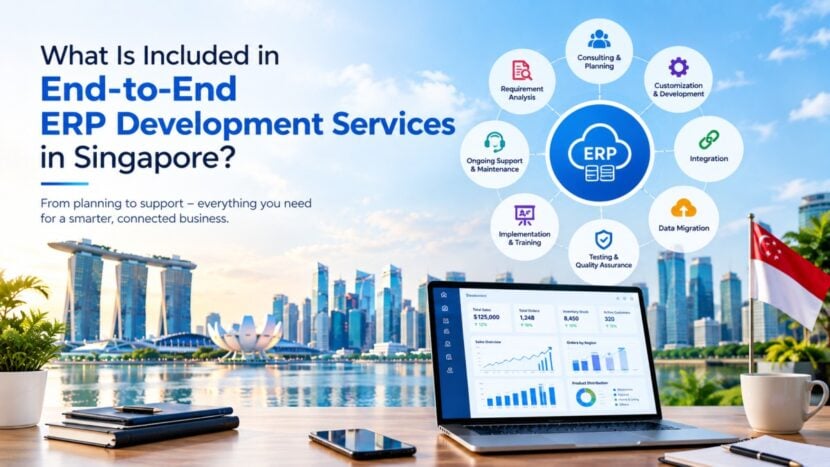
Running a business with disconnected software can make everyday operations more complicated than necessary. Finance teams may work with spreadsheets, warehouse staff may use separate inventory tools, and management may struggle to obtain accurate business reports. End-to-end ERP Development in Singapore helps organisations address these challenges by bringing essential business activities into one connected system.
An Enterprise Resource Planning (ERP) solution is designed around how a company operates. A full ERP development project comprises a number of crucial phases, from comprehending business requirements to offering post-launch assistance.
1. Understanding Business Requirements
Every successful ERP project starts with understanding the business rather than immediately writing code. Developers examine existing processes, identify repetitive tasks, and discuss the challenges employees experience in their daily work.
This assessment determines which functions require automation, what information different departments need, and how the new system should operate. The final project plan details the suggested features, timetable for implementation, technical specifications, and projected expenses.
2. Developing ERP Modules for Business Operations
Custom ERP development allows businesses to organize their software in accordance with their real-world operations. Instead of forcing employees to adapt to unsuitable processes, developers can create modules that address specific operational needs.
Depending on the organisation, these modules may cover:
- Finance and accounting: Expense tracking, financial records, invoicing, and reporting.
- Inventory and procurement: Stock monitoring, supplier records, and purchase orders.
- Human resources: Employee information, attendance, leave management, and payroll workflows.
- Sales and customer management: Customer records, sales activities, and order processing.
- Production and project management: Resource allocation, production schedules, and project tracking.
The selected modules work together to provide a more consistent view of business activities.
3. Connecting Existing Business Applications
Accounting software, CRM platforms, e-commerce systems, and payment apps are already used by a large number of Singaporean businesses. Replacing every existing tool may not be necessary.
ERP integration connects suitable applications so that information can move between systems with less manual intervention. Developers may establish API connections, synchronise records, and configure automated workflows based on the available technologies.
4. Migrating and Organising Business Data
It takes more than just importing files to move data into a new ERP platform. Data migration services involve reviewing source data, correcting errors, mapping fields, and transferring approved information into the new environment. Developers then validate the migrated records to confirm that important business information remains accurate.
5. Testing Security and System Performance
Before implementation, the ERP platform needs to be tested under realistic working conditions. Developers check individual features, connected applications, reporting accuracy, and the performance of important workflows.
Security testing also examines user permissions and access controls to ensure employees can access information appropriate to their responsibilities. User acceptance testing allows staff to try the system and identify issues before it becomes part of their daily routine.
6. ERP Deployment and Employee Training
The ERP solution can be implemented in a cloud environment, on corporate infrastructure, or through a hybrid arrangement when testing is over. Implementation services include system configuration, user account setup, deployment planning, and workflow activation. Employee training is equally important because even well-designed software can be difficult to adopt without proper guidance.
7. Maintenance and Continuous Improvement
Business requirements rarely remain unchanged. Companies may introduce new services, expand into additional markets, or modify their internal processes.
Ongoing ERP maintenance helps the software keep pace with these developments. Support services can include troubleshooting, software updates, performance optimisation, security improvements, backups, and the development of additional features.
Regular reviews also help identify opportunities to simplify workflows and improve system usability.
Why Singapore Businesses Invest in ERP Development
A properly implemented ERP solution can improve coordination between departments, reduce repetitive administrative work, and provide management with more reliable operational information. It can also support business expansion by allowing new modules and integrations to be introduced when needed.
For Singapore organisations, the system should be designed around applicable local business, accounting, tax, and data-protection requirements.
Conclusion
End-to-end ERP Development in Singapore covers the complete journey from business analysis to long-term system maintenance. Businesses may create an ERP system that enhances collaboration, facilitates well-informed decision-making, and adjusts to evolving company requirements by choosing an experienced development partner and establishing precise project objectives.