
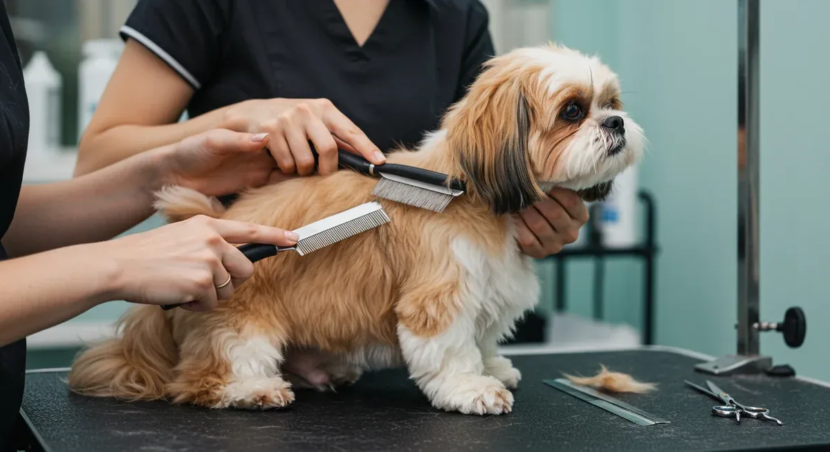
Dog grooming health indicators visible in the coat and skin are among the most reliable early signals that something in a dog’s overall health picture has changed — and professional groomers who see a dog regularly are often the first to notice them. Most owners focus on grooming as a maintenance activity — keeping the coat clean, trimmed, and mat-free — without fully recognizing that a groomer who knows their dog well is also performing ongoing health monitoring every time that dog is on the table. Understanding what groomers are observing, and what those observations can signal, helps owners make better use of grooming appointments as part of their dog’s overall wellness routine.
Why the Coat Is a Health Report Card
A dog’s coat condition reflects what’s happening internally in ways that aren’t always visible through casual observation at home. Nutrition, hydration status, hormonal balance, skin health, and systemic illness all express themselves through changes in coat texture, density, sheen, and shedding patterns. A coat that was consistently glossy and full that becomes dull, brittle, or starts shedding excessively without a seasonal explanation is communicating that something has changed — nutritionally, hormonally, or in terms of overall health status.
Professional dog grooming appointments that happen on a consistent schedule create the longitudinal baseline that makes those changes detectable. A groomer seeing a dog for the first time has no reference point for what that dog’s coat normally looks like. A groomer who has worked with the same dog consistently over months or years has exactly that reference — and notices when the coat that was always dense and shiny starts showing the dullness and thinning that might indicate a thyroid issue, or when the previously healthy skin shows the flaking and irritation that might signal a food sensitivity developing.
What Skin Changes Signal
The skin under a dog’s coat tells a story that the coat surface alone doesn’t always reveal. Flaking and dandruff suggest either environmental factors like low humidity or dry heat, nutritional deficiencies particularly in essential fatty acids, or underlying skin conditions that warrant veterinary attention. Redness or irritation concentrated in specific areas — around the face, paws, or belly — is a classic presentation pattern for environmental or food allergies. Unusual lumps, bumps, or thickened areas of skin that weren’t present at the previous appointment warrant documentation and communication to the owner.
Hotspots — areas of acute moist dermatitis that develop when a dog licks or scratches at an irritated area — can develop and worsen rapidly between grooming appointments but are immediately apparent when the coat is parted during grooming. Early identification of a hotspot before it becomes severely inflamed saves the dog significant discomfort and the owner a more complicated treatment process.
Ear Health as a Grooming Appointment Constant
Ear health is one of the most consistent dog grooming health indicators that professional groomers monitor at every appointment. Dogs with floppy ears, dogs prone to ear infections, and dogs with heavy coat growth in the ear canal are all at elevated risk for the moisture accumulation and bacterial or yeast growth that produces ear infections — and the early signs of developing infection are often detectable during grooming before the dog is showing obvious discomfort.
The smell of a healthy ear versus one beginning to develop an infection is distinct to an experienced groomer, and the visual presentation of the ear canal — color, discharge, hair condition — provides additional information. A groomer who mentions that a dog’s ears looked or smelled different from the previous appointment is providing clinically relevant information that owners should take seriously and follow up on with a veterinary assessment.
Nutrition’s Direct Effect on Coat Quality
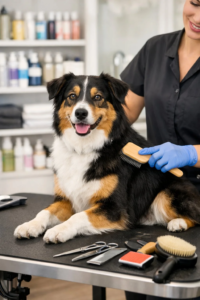
The relationship between diet quality and coat condition is direct and well-established. Essential fatty acids — particularly omega-3s and omega-6s — are the primary dietary factors affecting coat sheen and skin moisture. Dogs fed diets deficient in quality protein or essential fatty acids consistently show it in their coat within weeks of the dietary change. Conversely, dogs transitioned to higher-quality nutrition with better fatty acid profiles often show noticeable coat improvement within a similar timeframe.
Groomers who notice coat quality declining often ask owners about recent dietary changes — a switch to a different food, a reduction in food quality, or the addition of supplements — because the timeline of dietary changes frequently correlates with the timeline of coat changes in ways that help identify the cause. That kind of observational continuity is only possible with regular dog boarding and grooming at the same facility where staff knows the dog’s history.
Making Grooming Work as a Wellness Partnership
The most valuable grooming relationship is one where the groomer functions as a genuine partner in the dog’s overall wellness rather than simply a maintenance service. That partnership requires consistency — the same groomer or grooming team seeing the same dog regularly enough to know what’s normal and notice what isn’t — and communication that flows both ways between the groomer and the owner.
Owners who treat grooming appointments as opportunities to check in on observations as well as to maintain coat condition get significantly more value from those appointments than owners who drop off and pick up without conversation. The dog’s daycare and boarding staff at the same facility extend that observational continuity across every day the dog spends there — building the complete picture of a dog’s health and behavior that no single appointment can provide.